

🎨 Step into the mind of Salvador Dalí — where reality twists, faces emerge from fruit, and landscapes hide secret images!
What if a single vase could be both a bowl of fruit and a human face at the same time? Or a barren landscape could hide dozens of human forms, each shifting as you look? Welcome to the world of Dalí’s paranoid-critical method — a daring artistic experiment where perception, imagination, and reason collide. In this article, we’ll explore how Dalí trained his mind to see multiple realities at once, why he turned paranoia into a creative superpower, and how his most famous works invite you to see the world differently. Prepare to question what you see, because in Dalí’s universe, nothing is ever just one thing.
1. Introduction
The paranoid-critical method, developed by Salvador Dalí in the early 1930s, represents a unique technique combining elements of psychoanalysis and perceptual play. Its primary goal is the creation of multiple images and hidden meanings within an artwork, allowing viewers to perceive several interpretations of the same object simultaneously. Dalí himself described the method as:
"a spontaneous method of irrational knowledge based on the critical and systematic objectivation of delirious associations" (Dalí, 1942).
The method draws on Freudian psychoanalytic concepts but differs from Surrealist automatism by preserving the artist’s conscious control over the creation of imagery (Etherington-Smith, 1992; Gibson, 1997).
2. Semantics of the Term: "Paranoid" and "Critical"
The method’s name reflects its dual nature:
-
Paranoid refers to the capacity to perceive hidden connections between objects, creating multiple interpretations and operating with paradoxical images.
-
Critical indicates the distance and control maintained by the artist: Dalí did not lose reason but consciously used mechanisms of paranoia as a creative tool (Dalí, 1964/1965).
Thus, the method represents an intellectually managed paranoia, allowing for the production of multilayered visual imagery.
3. The Paranoid-Critical Method for the Layperson
To explain the method in simple terms:
"Imagine looking at a cloud or a stone and suddenly seeing multiple forms—animals, faces, or objects. Dalí’s method trains you to do this consciously, holding several images at once and using them to create a painting that ‘speaks’ on multiple levels" (Pitxot & Ager, 2010).
In other words, it is a game of perception and imagination, where the artist acts as a detective of his own imagination, exploring how the irrational can become artistically significant.
4. Differences from Classical Surrealism
Classical Surrealism, as formulated by André Breton, sought the removal of rational control through automatism, spontaneous writing, and random associations (Breton, 1924). Dalí’s paranoid-critical method differs in that it:
-
involves active interpretation of imagery, not passive recording of chance occurrences;
-
produces dual and multiple images that coexist within a composition;
-
merges the irrational with analytical critique, making the method a form of artistic epistemology (Ades, 1982).
5. Practices for Inducing Altered States of Consciousness
Dalí deliberately developed techniques to activate paranoid perception and expand consciousness. These practices prepared the artist for the paranoid-critical method and heightened sensitivity to multivalent imagery.
5.1. "The Sleep with a Key in Hand"
Dalí used hypnagogic states, the transitional period between wakefulness and sleep. He would hold a metal object, usually a key, in his hand while seated, and when the hand relaxed and the object fell, the sound would startle him awake, capturing fleeting images from his half-dream state (Dalí, 1942).
This allowed him to:
-
record strange, irrational images appearing only in transitional consciousness;
-
use these as visual and conceptual elements for future paintings;
-
train the ability to simultaneously perceive multiple interpretations of a single object.
5.2. Self-Induced Paranoia
Dalí intentionally created artificial paranoid states:
-
concentrating on objects, architectural details, or natural forms;
-
attempting to see multiple interpretations within a single element;
-
using mirrors to multiply and distort perception, producing a “double vision” effect.
This cultivated the ability to perceive multiple layers of meaning simultaneously (Pitxot & Ager, 2010).
5.3. Observing Ambivalent Forms
Dalí practiced extended observation of ambiguous objects: clouds, stones, fabrics, and architectural elements. This included:
-
focusing on shadows and contours;
-
identifying repeating or mirrored shapes capable of creating new images;
-
mentally linking details into unexpected combinations.
This developed the capacity to hold multiple visual interpretations at once, turning observation into an active intellectual and artistic exercise (Descharnes & Néret, 1994).
5.4. Psychophysiological and Visual Experiments
Dalí experimented with body and vision:
-
deliberate attention fatigue to enhance sensitivity to subtle details;
-
manipulation of light and shadow to reveal hidden forms;
-
micro-movements of eyes and head to perceive objects from multiple angles.
These methods facilitated immersion in an intermediate state of consciousness, where images overlap and interact, forming complex visual and conceptual patterns.
5.5. Combining Techniques
Dalí often combined methods—e.g., cloud observation with mirrors and recording visions after hypnagogic sleep—allowing him to:
-
create catalogs of potential images;
-
develop the ability to see double or triple meanings in objects;
-
prepare for the conscious application of the paranoid-critical method.
These practices show that for Dalí, art was simultaneously a visual and mental experiment, with the method serving as a systematic approach to the irrational.
6. Analysis of Key Works
6.1. Apparition of Face and Fruit Dish on a Beach (1938)

This painting demonstrates Dalí’s signature technique of dual and multivalent imagery. At first glance, it depicts a vase with fruit against a seashore. Upon closer observation, the arrangement of the vase and fruit forms a human face, where:
-
the bowl of the vase serves as the forehead and nose bridge,
-
the stem acts as the nose,
-
the base forms the chin,
-
the fruits resemble hair.
Both interpretations coexist, exemplifying the paranoid-critical principle of simultaneous multiple readings (Barcelona-Excurs, 2026). The painting also includes secondary, smaller repetitions of the forms, adding a layer of narrative and variation akin to Dalí’s Metamorphosis of Narcissus. The work requires active engagement from the viewer, transforming perception into a dynamic interpretive experience.
6.2. El Gran Paranoico (1936)
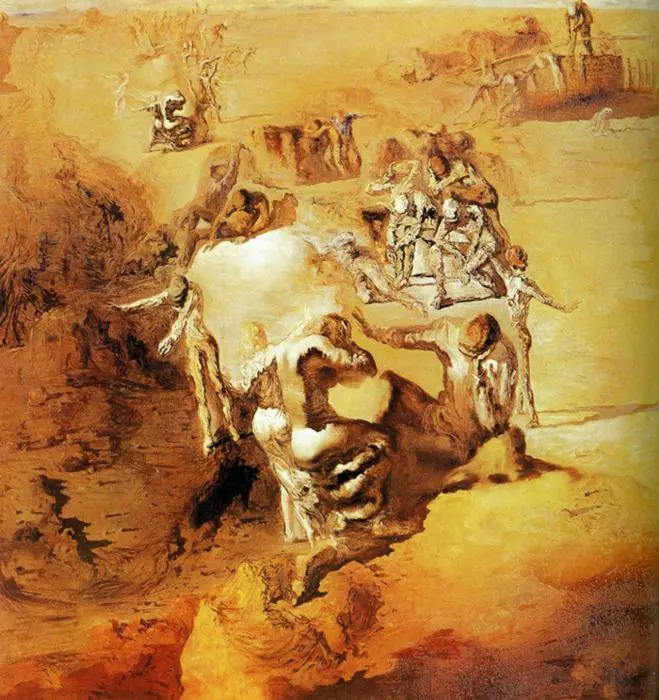
El Gran Paranoico (The Great Paranoid) exemplifies Dalí’s use of emergent, overlapping human forms. In a barren landscape, multiple heads and bodies simultaneously function as discrete figures and collectively form larger, composite structures, illustrating the method’s core concept: a single visual field containing autonomous and interrelated images.
Dalí’s conscious structuring compels viewers to toggle between interpretations, engaging both perception and cognition. The figures appear to materialize from the surrounding space, reflecting Dalí’s early practice of perceiving hidden images in ceilings and walls. The painting emphasizes active viewer participation, mirroring the artist’s own mental engagement in producing layered visual illusions (Barcelona-Excurs, 2026).
7. Conclusion
The paranoid-critical method of Salvador Dalí is a system of artistic cognition, merging irrationality and analytical control. Through specific practices for altering consciousness and multilayered composition, Dalí created multiple visual interpretations that require viewer interaction. Analysis of Apparition of Face and Fruit Dish on a Beach and El Gran Paranoico demonstrates the method’s practical implementation, revealing the intellectual and perceptual mechanisms behind his work.
8. Was There Really a Method?
Raising the question of the authenticity of Salvador Dalí’s paranoiac-critical method inevitably leads to a deeper and, in many respects, paradoxical conclusion. On the one hand, the analysis demonstrates that Dalí’s method largely meets the principal criteria of methodological authenticity: it is intentional, goal-oriented, productive, repeatable, and clearly distinct from a mere set of artistic devices. On the other hand, its limited formalizability and weak transferability call into question the possibility of recognizing the paranoiac-critical method as a universal instrument of artistic cognition.
The most subtle and decisive criterion in this context is that of control and reflexivity, for it is precisely this criterion that marks the boundary between a method as a cognitive practice and an uncontrolled irrational state. Dalí consistently emphasized that his paranoia was not clinical in nature. Unlike psychiatric paranoia, in which the subject loses critical distance from delusional constructions and accepts them as objective reality, the paranoiac-critical state presupposes the preservation of analytical distance, discrimination, and evaluative judgment. The irrational associations that arise do not overwhelm consciousness but instead become objects of observation and interpretation.
The imagistic material generated in an altered state of consciousness is therefore not accepted uncritically. It undergoes selection, interpretation, and compositional organization. In this respect, Dalí fundamentally distances himself both from clinical madness and from Surrealist automatism in its classical, Bretonian formulation. Whereas automatism sought to eliminate rational control in order to give voice to the unconscious in its “pure” form, the paranoiac-critical method is built upon a tension-filled coexistence of the irrational and the analytical. The unconscious is not liberated from control; it is deliberately employed as an instrument.
In this sense, Dalí’s method may be compared to a scientific experiment in which the artist simultaneously occupies the position of researcher and object of investigation. He intentionally introduces his own consciousness into a borderline state, observes the resulting phenomena, and subsequently analyzes their outcomes. Unlike a scientific experiment, however, this procedure cannot be standardized or reproduced independently of the individual experimenter. Its effectiveness depends directly on the artist’s intellectual discipline, cultural training, and capacity for sustained self-reflection.
It is here that the dual nature of Dalí himself as both artist and thinker becomes particularly evident. His emotional intensity, imaginative excess, and obsessive inward focus coexisted with a cold analytical intelligence, a drive toward systematization, and continuous self-examination. This inner division did not weaken the method; rather, it made it possible. Without a developed capacity for analysis, the irrational material would have remained a chaotic stream of images incapable of artistic articulation.
Dalí repeatedly insisted on the distinction between madness and what he termed the “use of madness.” His method does not imply immersion in the irrational but rather mastery over it. At the same time, this heightened critical awareness and analytical vigilance became a source of inner tension. As Dalí once remarked with characteristic irony:
“I will never be a good painter — I am too intelligent for that.”
Behind this provocative statement lies a precise self-diagnosis. Creativity, by its nature, is largely irrational, pre-rational, and impulsive. Dalí, however, despite possessing an extraordinary imagination, felt an almost irresistible need to analyze, classify, and systematize. The paranoiac-critical method thus represents an attempt to contain the irrational within the framework of analysis — without destroying it, yet without surrendering to it.
Accordingly, the question “Was there really a method?” admits a dual but non-contradictory answer. Yes, the paranoiac-critical method existed as a conscious, productive, and reflexive system of artistic thinking. At the same time, it was inseparable from Dalí’s personality, from his psychological constitution, and from his paradoxical gift for uniting fantasy and analysis, madness and control. For this reason, the paranoiac-critical method should perhaps be understood not as a universal model of artistic cognition, but as a unique intellectual instrument, devised by the artist primarily to investigate his own consciousness — and through it, the very nature of creative thought.
9. Bibliography
-
Ades, D. Dalí and Surrealism. London: Thames & Hudson, 1982.
-
Barcelona-Excurs. “Mediumistic Paranoiac Image.” URL: https://www.barcelona-excurs.org/mediumistic-paranoiac-image [Accessed 08 Jan 2026].
-
Barcelona-Excurs. “Gran Paranoic.” URL: https://www.barcelona-excurs.org/gran-paronoic/ [Accessed 08 Jan 2026].
-
Barcelona-Excurs. “Apparition of Face and Fruit Dish on a Beach.” URL: https://www.barcelona-excurs.org/apparition-face-fruit-dish/ [Accessed 08 Jan 2026].
-
Breton, A. Manifesto of Surrealism. Paris, 1924.
-
Dalí, S. Diary of a Genius. New York: Doubleday, 1964/1965.
-
Dalí, S. The Metamorphosis of Narcissus. Paris: Éditions surréalistes, 1937.
-
Dalí, S. The Unspeakable Confessions of Salvador Dalí. Paris: André Parinaud, 1976.
-
Dalí, S. The Secret Life of Salvador Dalí. New York: Dial Press, 1942.
-
Dalí, S., Halsman, F. Dali’s Mustache: A Photographic Interview. New York: Simon & Schuster, 1954.
-
Descharnes, R., Néret, G. Salvador Dalí: The Paintings (illustrated edition). Cologne: Taschen, 1994.
-
Descharnes, R., Néret, G. Salvador Dalí 1904–1989. Cologne: Taschen, 2000.
-
Etherington-Smith, M. The Persistence of Memory: A Biography of Salvador Dalí. London: Random House, 1992.
-
Gibson, I. The Shameful Life of Salvador Dalí. New York: Norton / Random House, 1997.
-
Lear, A. My Life with Dalí. London: HarperCollins, 2000.
-
Pitxot, A., Ager, M. Dalí Theatre-Museum, Figueres: Album / Guide. Figueres: Gala-Dalí Foundation, 2010.
-
Pérez, M. “El método paranoico-crítico de Salvador Dalí.” Revista de Arte Contemporáneo, 12(3), 2016, pp. 45–62.
-
Rodríguez, L. “Dalí y la memoria de los sueños.” El País, 23 April 2017. URL: https://elpais.com/cultura/2017/04/23/dali-suenos.html [Accessed 08 Jan 2026].
-
Gala-Salvador Dalí Foundation. Catalogue of the Works of Salvador Dalí. Figueres: Gala-Dalí Foundation, 2015.
-
Various authors. Salvador Dalí: Exhibition Catalogue, 1904–1989. Paris: Centre Pompidou, 2004.

Статьи по теме:
11 интересных фактов о Гала Дали
Сальвадор Дали - интересные факты

Write a comment